*REVIEW* 3A Square Bomb

Today is a special day for me because today my wife has taken over and written her first toy review! Not only did she do the write-up, but she shot all the photos as well. I’ll add a few of my own thoughts here and there as well to spice things up, but the majority of the following is all her!

Also at the end of this review is Rad Toy Review’s very first unboxing YouTube video! We’re still working out the kinks but it’s a good start and we’re excited to see where it takes us!

– Knives

INTRO

Hi all! Knives’ wife (sometimes called The Red Lady) here. I didn’t think it was possible for toys to take over any more of husband’s life until this website came along. To my chagrin, it immediately proved my theory wrong. I mean, really, who writes over 4,000 words about a toy? I don’t think he ever even wrote that much for school assignments! I feel if I have any hope of spending time with him ever again, I’m going to have to get involved with this toy business occasionally. So here I am! He’s asked me to share my perspective for this review, as a non-collector and “outsider” of sorts. While I won’t pretend to understand his relentless drive to collect toys and subsequent obsession with them, as a creative type, I do think some look pretty cool, so I’ll do my best to be fair and not let my personal feelings of abandonment color my words 😉 On to Mr. Square Bomb!

PACKAGING

The box he comes in is…well, it’s a box. Garden variety corrugated cardboard, white on the outside, brown on the inside. Other than the (comparatively rather large) threeA logo, the artwork is all black, white and orange. It’s simple, but kind of a neat look. I don’t really get the word bubble on the side, though. I guess it’s supposed to be what the square thinks, but it’s way too serious to come out of that goofy face.

K – The only thing I’d like to add about the packaging is actually about the brown shipping box it comes in. On the side clearly reads the words “SQUARE BOMB”. Yes, 3A has sent us all bombs in the mail. Prominently labeled as such. I wonder how many (if any) of these were held up in customs because of it. 

WHAT’S INCLUDED

Just the toy. Unless you’re super creative, and then I guess you could maybe do something with the plastic shell pieces?

THE BREAKDOWN

I’m going to ‘fess up here and admit that while I regularly give Knives a hard time about his “Ash” obsession, I actually really like some of Ashley Wood’s art (I could happily live without the scantily clad women with weird looking feet) and think a lot of his toys are pretty neat looking. The squares are definitely my favorite. Simple, but they have personality and are pretty cute. And before you go thinking I’m all girly and I just like cutesy things, know this – when the zombie apocalypse comes, I’m the one in this household that knows how to handle a weapon.

Ahem. Now that we have that cleared right up…
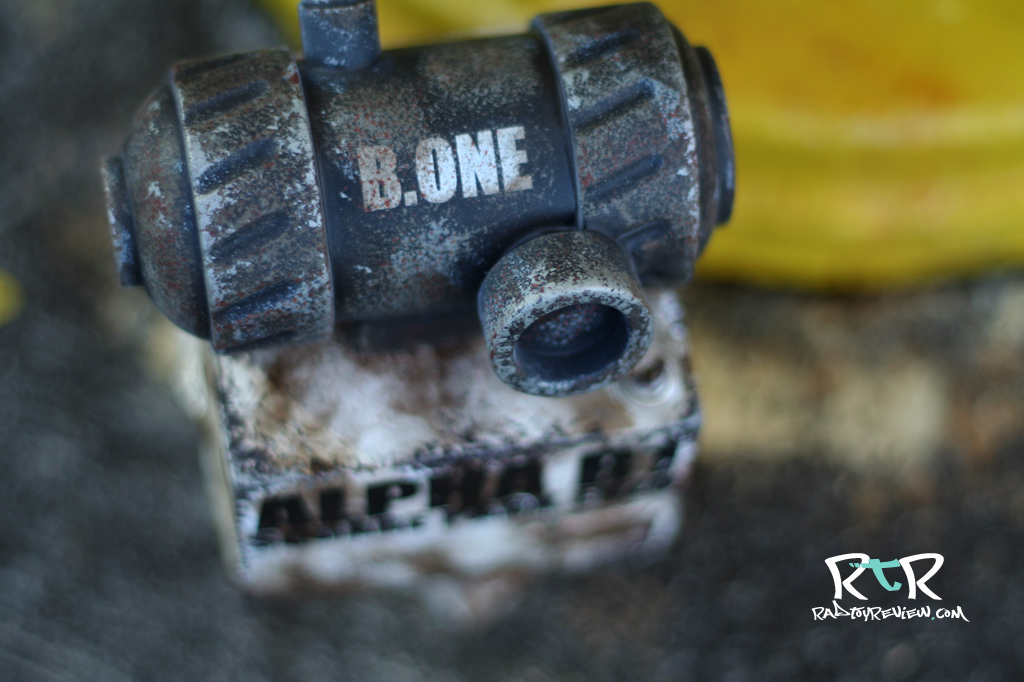
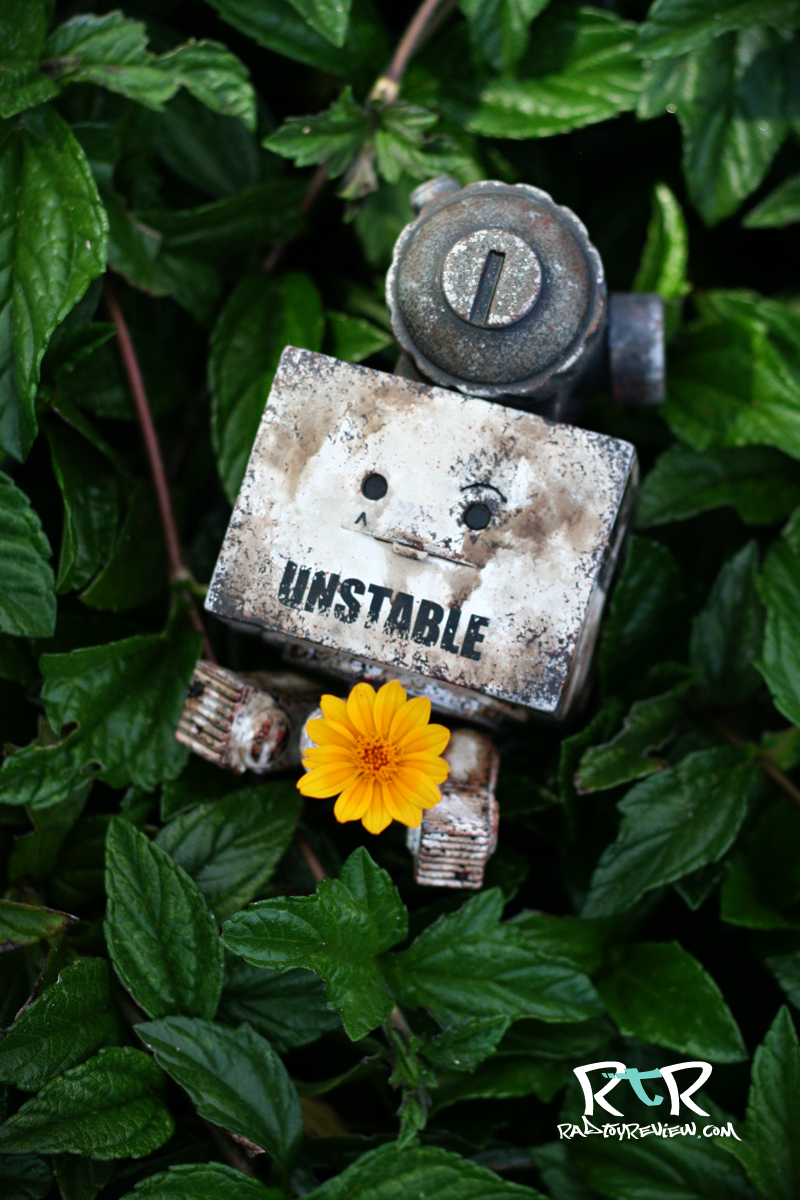
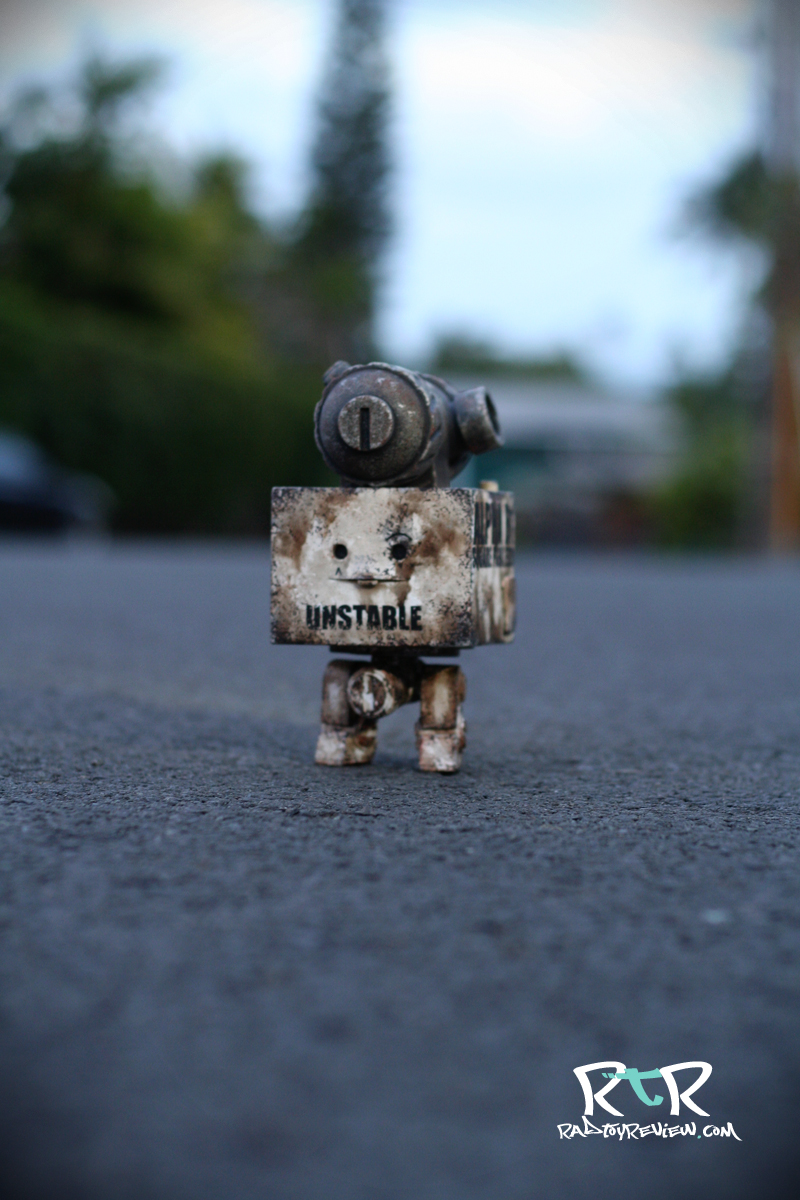
This square is a little different than the others, mostly because he’s carrying a giant bomb on his noggin. I’m not sure how he intends to use it, given that he lacks arms, but it’s there.  His face is a little different than the other squares too. He still has that bucktooth thing going on, but his lip is far less curled out. I know he’s supposed to be the “crazy” one, on account of the word “unstable” printed on his face in giant block letters (subtle, no?), but he actually looks a little less crazy than the normal squares because of the lip. He’s also got one pretty sweet eyebrow over his left eye. He seems very sneaky to me!

I’m really impressed with how much articulation he has for a toy with so few appendages. Knives tells me it’s about the same as the other squares, but I guess this is the first time I really played with one. You can twist the base that the legs attach to all the way around, rotate and twist the top of the legs around a ball joint and even twist his feet back and forth a bit. Unfortunately, with so many options and his top-heavy nature, it was a little difficult to get him to actually stand up while photographing.

One of the things I think is so cool about these toys is the interesting paint jobs. The weathering and detail are (normally) great. This guy looks like he’s had dirty water running down him along with the normal weathering detail on the edges. There’s also some reddish splatter in there that breaks things up nicely.

Given that I’m usually such a fan of the paint though, I’ve gotta say I think they really phoned it in on the bomb. It’s a random assortment of red, brown and silver splatters that don’t make any sense to me, and are applied in a really lazy manner. There’s about four smudge marks around the main body of the bomb, with each color right on top of the other in the exact same spot, and anywhere with a dip is completely free of paint.

FINAL THOUGHTS

Overall I like this little guy. He’s got personality. It was pretty easy to come up with a little back story for him while taking pictures. If you don’t look too close, the paint job looks nice. The only other issue I had with him is that it’s pretty unclear how the bomb is attached. The belly of the bomb just kinda squares out, sitting flush to the top of his head. I feel like this was a missed opportunity for cool detail that would sell the whole bomb thing a little better.

Well, thanks for sticking around long enough to read the thoughts of the uninitiated! It’s been fun. I’m sure I’ll start to miss Knives again soon and have to come back for another!

K – Personally, I wasn’t too excited about square bomb when I ordered him. I ordered him based on the single fact that I love the MK1 Square. It’s a 3A/Ashley Wood classic. I was intrigued by the new face but the bomb didn’t look very “realized” in the teaser shots. I had my hand firmly on the trap door when he arrived only to be surprised by his “personality”. The new face won me over right away. Also, as my wife mentioned, the paint and weathering is well done. Perhaps just as important, not OVER done. There’s a good balance of dirty and clean and some nice attention to details around the edges and corners of the square’s body. It’s not the best I’ve seen 3A do, but it’s pretty darn good. I’ll agree with my wife that the bomb did lack some of the finer paint details of the square, but it didn’t bother me as much as it did her.

I think the thing I like about this guy the most is that he’s a one-off. One character with a unique face and a singular idea behind him. That could all change tomorrow and 3A could release a dozen different colorways of the bomb toting psycho, but for now he’s unique and I love that.

I do wish the bomb had some straps around it, or maybe some hoses running from it into the square’s body to make it a little more cohesive. This is 3A. They do straps and belts and hoses and bags like it’s their job.. because IT IS their job! It just looks like it’s stuck on with no basis of how or why. Some simple accessory connecting the two would have gone a long way I think.

Other than that I’d like to echo my wife’s feelings and say that overall I like this little guy. Thanks sweetie for putting this all together for me! You’re the best!

Pros:

  • wonderful new “troubled/sneaky” face
  • nice overall paint application
  • A unique character based off one of 3A’s most classic (and one of my favorite) toy designs

Cons:

  • The general execution of the bomb, from the way it’s painted to the way it’s attached looks less than inspired
Check out the first ever Rad Toy Review unboxing video!

Help us improve this site by letting us know what you think! Follow us on Facebook and Twitter to stay updated!

THE WORKSHOP – Weathering by Paul Benson

In this humble web dude’s opinion, if there is one thing regular “The Workshop” contributor Paul Benson is amazing at.. it’s creating realistic weathering on just about anything.  In today’s workshop Paul’s going to walk you down the beach of learning and show you step by step how he achieves such believable results.

Enjoy!

– Knives

Weathering 
As we know weathering tends to be a geographical term referring to and I quote “Any of the chemical or mechanical processes by which rocks exposed to the weather undergo changes in character and break down”.  In the modelling world (not the one involving catwalks!) weathering is a whole variety of techniques used to simulate dirt, fading, spills, paint wear and tear, rusting, etc.

In this article I wanted to show how a 1/6 scale “heavily used” item might be weathered using various paint and weathering pigment techniques. A simple shovel seemed to fit the bill just right!  While the techniques I use here work well for me, they are not the only way to achieve good results.  Sometimes it can simply depend upon the paints and weathering powders you have at your disposal and how they work together. Try different things out and see what works for you!
It important to have a starting point. A good idea is to look at real world 1:1 scale objects to see how actual weathering affects them e.g. equipment, machinery, tools, fencing etc.  You need to have some idea of how dirt and mud end up on objects, what dirt and oil stains look like, how rusting might occur and leave it marks etc. I have found the workshop articles in military modelling magazines very informative. Tank and armoured vehicle modellers seem to be the masters at weathering so your sure to pick a thing or two up from them if you look at their work.

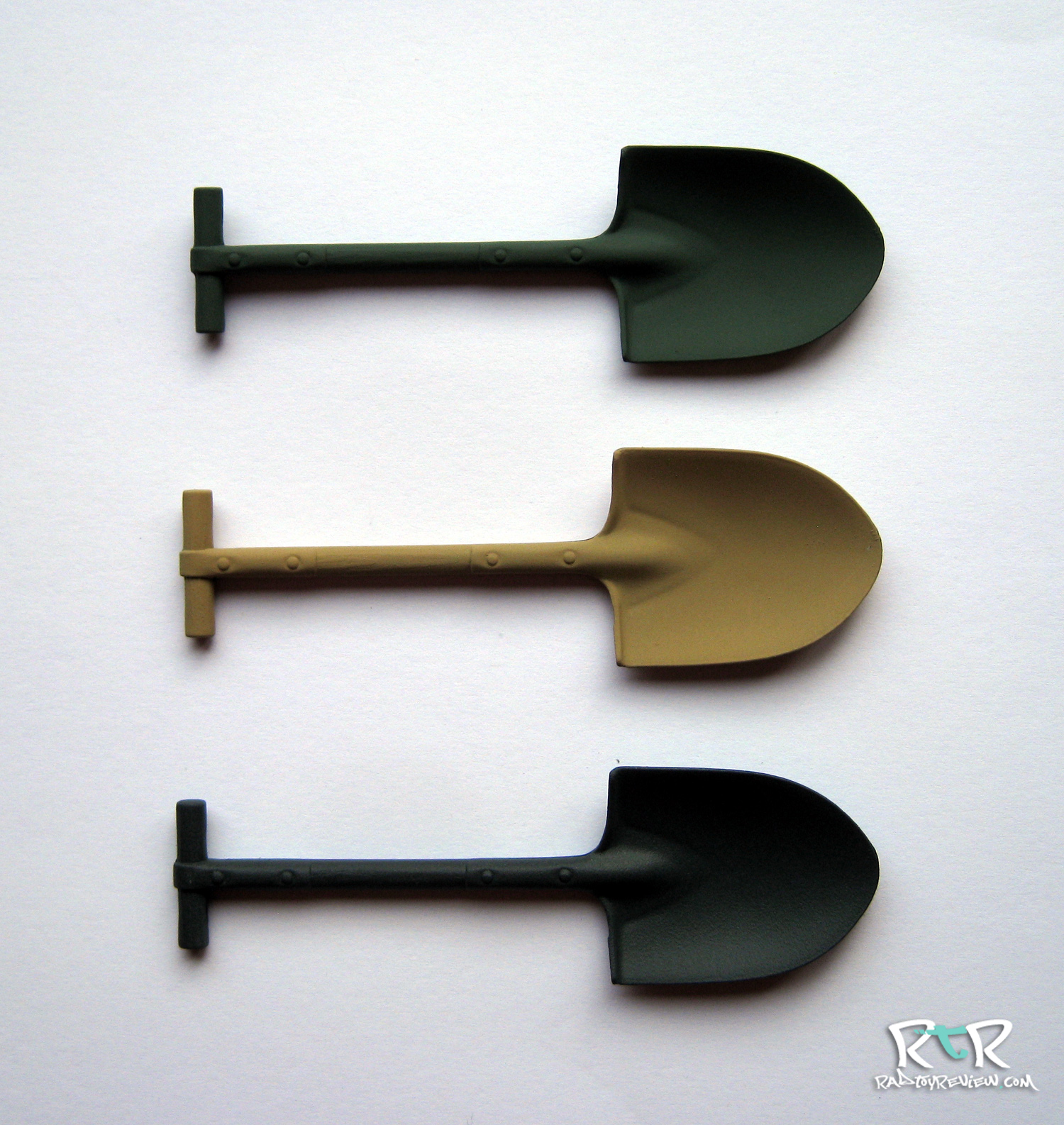
To start this project off, I got three plastic 1/6 scale shovels courtesy of E__y.

pic x Paul Benson

The article will deal with how I painted three shovels, each with a different base colour to show weathering.
In other Workshop articles I have described the paints and materials I use.  Generally I put on a base coat first with Humbrol acrylic aerosol paint, then I use Citadel acrylic paints (obtained from Games Workshop or hobby stores) and MIG weathering pigments.  MIG weathering pigments come in a range of colours for soil/mud/dirt staining and for rust/oil stains.  A substitute can easily be made by using artist pastels as they work in the same way.  Take a suitably coloured pastel and rub it back and forth on fairly fine sandpaper or a nail file.  They can be stored individually and used as such or combined.The first thing to tackle with the shovels was to remove the cast lines with sandpaper and a file.  The shovels were then washed in warm water with a bit of detergent, this was to remove any factory grease marks.  Then I sprayed one was sprayed with Humbrol Desert Yellow, the next Dark Green and the third with Tank Grey.

pic x Paul Benson

The shovels were then left overnight for the paint to dry.  To add a little wear to where paint may have thinned, each shovel was dry brushed with as near a colour to the base coat as possible mixed with a little white.  So for the desert camo shovel this meant using GW Desert Yellow mixed with Skull White. It’s subtle, but effective.

pic x Paul Benson

Next to chip the base paint back to the undercoat. A darkish grey was made up with GW Chaos Black and Skull White, this was then dabbed onto the shovel where paint chips would occur using small pieces of cut sponge. I have found that by dabbing on a piece of paper first several times, removes paint until just enough is left to leave clear dots and specks on the piece you are working on.  Small scratches were painted in with a fine paint brush.  Shovel 3 was going to be the most rusted of the three, so small rust marks were applied with a sponge using GW Dark Flesh.

pic x Paul Benson

Now general rust and rust staining were applied.  I used MIG weathering pigments New and Old Rust.  Weathering pigments can be applied in several different ways.  They can be mixed with water or a binding agent and washed over a piece or they can be applied dry.  For these shovels it would be more appropriate to apply them dry.  Using a stiff brush or a cotton bud (never thought that I would end up using these, but I happened to try one of my wife’s supply and found them very useful) I used the two pigments individually or blended to rub across the shovels.  To put on a thicker layer the pigments can be dabbed on with a sufficient amount of water to make a paste and then rubbed in.  A stiff brush, kitchen paper or a finger, dry or damp, can be used to blend the pigment across flat surfaces and will tend to leave pigment in depressions.

pic x Paul Benson

pic x Paul Benson

The next step was to pick out areas worn through to bare metal.  For all three shovels GW Boltgun Metal was dry brushed onto areas where wear had occurred because of knocks and general erosion to the blade caused by digging.

pic x Paul Benson

pic x Paul Benson

Time to add the dirt.
For desert camo shovel I used MIG Gulf War sand.  I mixed this pigment with a little white acrylic to act as a binding agent.  This was painted onto the end of the spade blade and then gradually wiped away with kitchen paper and my finger until I got the effect I wanted.  With the green shovel I just used MIG Dried Mud mixed with a lot of water. This was then painted onto the blade end of the shovel and then allowed to dry.  The same technique was used on the reverse.  For the grey shovel I just added more rust with MIG Old and New Rust!
At this point because of handling the bare metal effect had dulled and so therefore I re-applied GW Boltgun Metal were needed.  As a final addition I dry brushed GW Mithril Silver to the bottom edge of the shovel blade and to where a boot had been placed during digging to represent metal that had been polished by wear.

pic x Paul Benson

pic x Paul Benson

There were several stops and starts on this project where I had done a little too much or too little weathering.   Occasionally too much paint or pigment had been applied. To fix this, vigorous rubbing with kitchen paper is usually sufficient to tone down the paint effect.  Unfortunately this can also polish the base coat and give it a shiny effect.  I usually correct this by spraying the piece with Humbrol acrylic aerosol Matt Varnish.
Sometimes errors need to happen and it gives you a chance to assess what you are doing and ask yourself “Does this look realistic?”, “Does this shovel look like it has been used a lot in a natural way? “Does this shovel look like it has been left out in all weathers?” etc.
We hope you enjoyed the latest Workshop. Thanks to Paul for once again putting this together for us. We hope it helps take  your weathering skills to another level!
 We’d love to hear from you and check out what kind of customs you’re working on! Send us a shot of your latest custom work with a brief description to radtoyreview@gmail.com. 

Hit us up on Facebook or Twitter pages to stay updated whenever we post new Workshops and epic toy reviews!

Until next time!


THE WORKSHOP – DIY Square Mule by Paul Benson

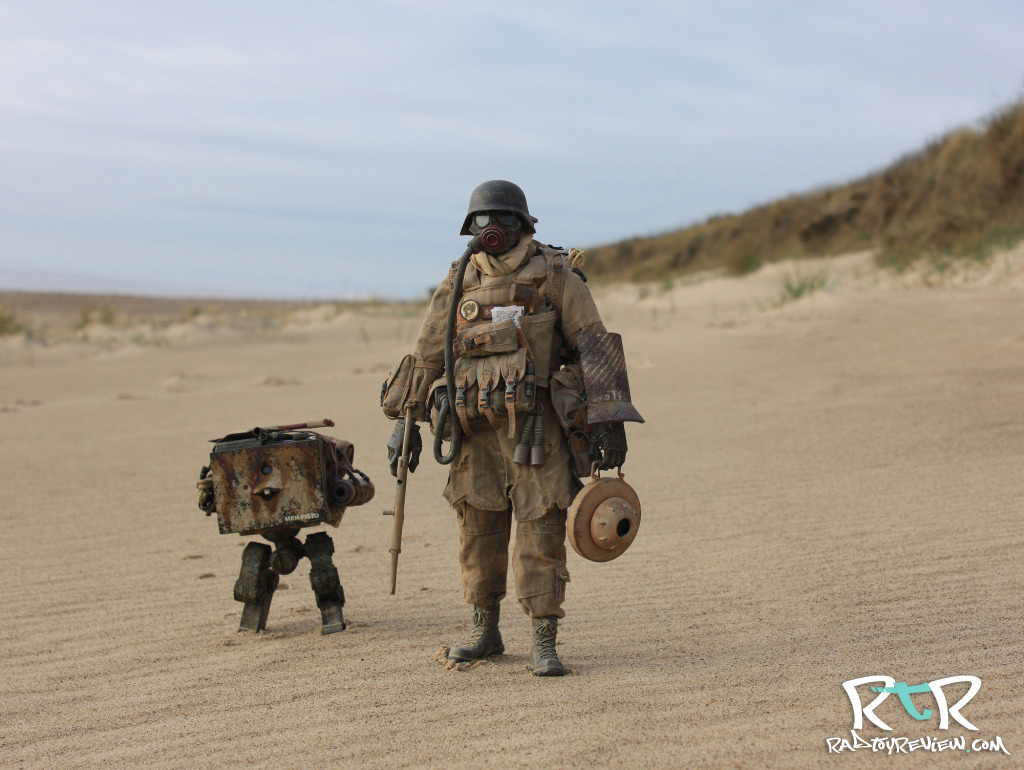
Paul Benson stopped by to show off his custom Desert Mule Square. Much of the gear shown was hand made and painted by Paul. He took some time out of his day to give an overview of his process of putting all the bits together to create a truly cohesive look.

Enjoy!

– Knives

The Square Mule

pic x Paul Benson

One of my favourite ThreeA figures is the Desert Grunt. I thought he could do with a ‘mule’ to carry his equipment and what better than the MK2 Square! With this “tutorial” I’ill go through each equipment item and try to explain how I painted it and if I made it, how I did so.  Some of the equipment might seem random, but I hope it looks like the kind of gear a Grunt would find useful when scouting or on maneuvers.

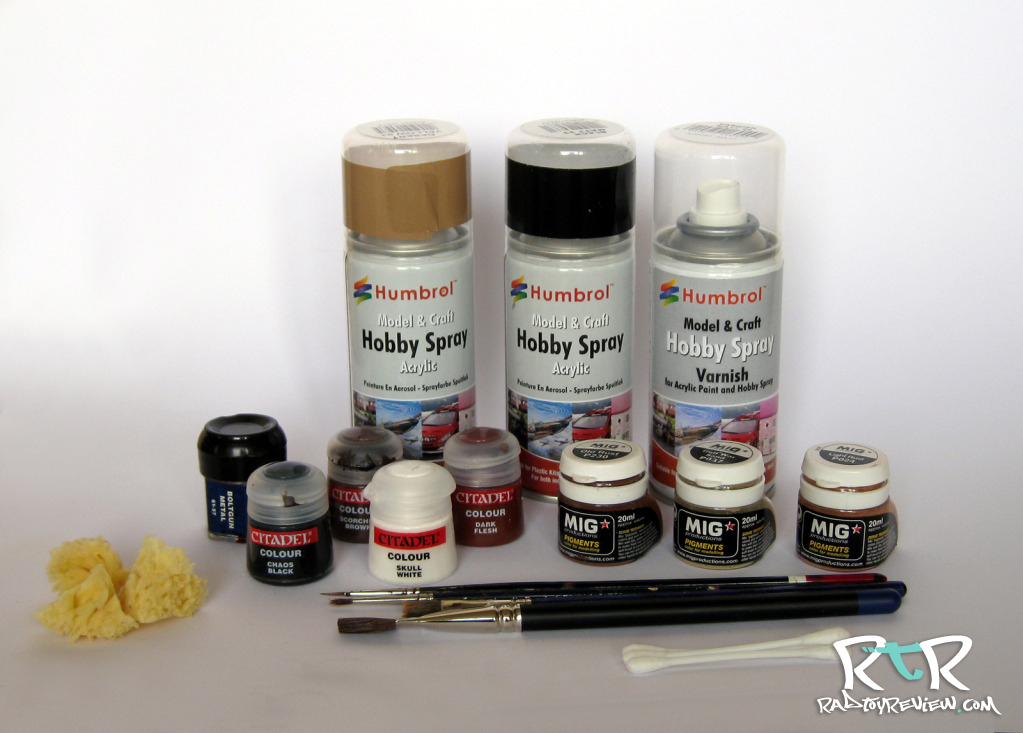
The main paints I used are shown below.

pic x Paul Benson

 The aerosol sprays are used to provide a base colour onto which other painting including paint chips and weathering is added with Games Workshop acrylic paints.  Games Workshop paints are very good and are easy to get hold of, either at a local store or online. They come in a range of both basic and very useful blended colours. The names of the paints, I might as well use them, are referred to below. Bits of sponge and old paint brushes were mainly what I used to do this piece. I use MIG weathering powders to apply further weathering, such as rust staining and accumulated dust and sand on equipment. Yes, those are cotton buds laying there. They are ideal for rubbing on the weathering powders.

pic x Paul Benson

1.  The webbing net was made from 10mm and 5mm Grosgrain and 1/6 side releases.  I used a green plastic cutting board with a square grid for spacing the webbing out accurately.  I sellotaped it down and then gluing with super glue as it went together.  The webbing was painted with desert sand acrylic paint.  To dirty-it up I used a wash of scorched brown and hint of chaos black.  I then drybrushed (a technique of wetting a brush with paint and then almost drying it and then wiping it across the area you are working on) with desert sand mixed with a little skull white.  Then finally to bring out the texture of the webbing weave, I lightly drybrushed with white again.  The pouches are swiped from my Desert grunt.  They were just drybrushed slightly with a desert sand/white mix to help them blend a little better.
pic x Paul Benson
2. No idea where the camo netting came from, I have had it for years. It seemed ideal for the task and already had a camo pattern, which I think of as the American chocolate chip. The netting was folded over to the correct length and then rolled and then tied with bits of thread. The strap was made from Grosgrain again. The net is plastic and has a slight sheen to it, so I sprayed it with matt varnish to kill it.  It was then dirtied up with a wash of scorched brown/black mix.  To finish, I lightly drybrushed with a desert sand/white mix. The strap was treated in the same way as the webbing net.
3. I needed a couple of bits of equipment that would appear to have some weight and when put into the webbing net pockets would pull the webbing net across and down over the MK2 square to give it a realistic lay and hang. I set about finding something made of metal. This bit of equipment is possibly an empty water or fuel tank. It actually an old a car touch up paint container I found in the garage. It even still contains some dried up old paint!  I cut off the end with the screw thread on.  To break up the length I thought a black band would be good idea.  So the container was sprayed with matt black first.  A thin strip of masking tape was applied and then sprayed again with desert yellow.  Using bits of sponge, paint chips were applied with grey made from chaos black and skull white.   Some of these would be left to represent chips through to the undercoat and then using boltgun metal and a brush some of the grey chips are gone over to represent chips through to the base metal.  Edges were drybrushed with boltgun metal.  Bits of rust here and there was painted in with dark flesh. Old and new rust staining was applied with a cotton bud in various places using the two rust weathering powders.
 

pic x Paul Benson

4. and 5. To add weight to the other side of the webbing net I used a little brass collar. Sprayed it black and then drybrushed it with boltgun metal, as I did with item 5 which is a spare metal fastening from a piece of Ikea furniture.
6.  Not sure a Grunt would have a laptop but closed, it looks like it could be a bit of general equipment!  It was already painted matt back, so I just dirtied it up with Gulf War Sand weathering powder.  I did this using a large brush and just applied it all over, rubbing it in, not that evenly, as I went along.  It stays in the depressions as dust and sand would.
7.  The air filter is from a WWII 1/6 gas mask.  Painted in the same way as item 3.
8. and 9.  I made this ‘grunt-portable antirobot weapon’ [(GRAW) which is a play on typical army descriptions used to describe anti tank weapons e.g. the bazooka etc.] some while ago. I will not go through how I made it in detail here.  It may be appropriate to do so in another article.  Essentially it is a WWII bazooka tweaked with styrene strips including tubing and other cross sections.  Again, it is painted in the same way as item 3.
10, 11 and 14. These are bits from 1/6 small arms, possibly a M4 which I had stripped down to make some 3A themed small arms. Items 10 and 11 are just sprayed black and then drybrushed with boltgun metal.  They are then dirtied up in the same way as item 6. Item is painted in the same way as item 3 again.
12.  The shovel is painted in the same way as item 3 again, although more weathering is applied to give the idea of heavy wear and tear.
13.  Ammunition magazines painted in the same way as items 10 and 11.

pic x Paul Benson

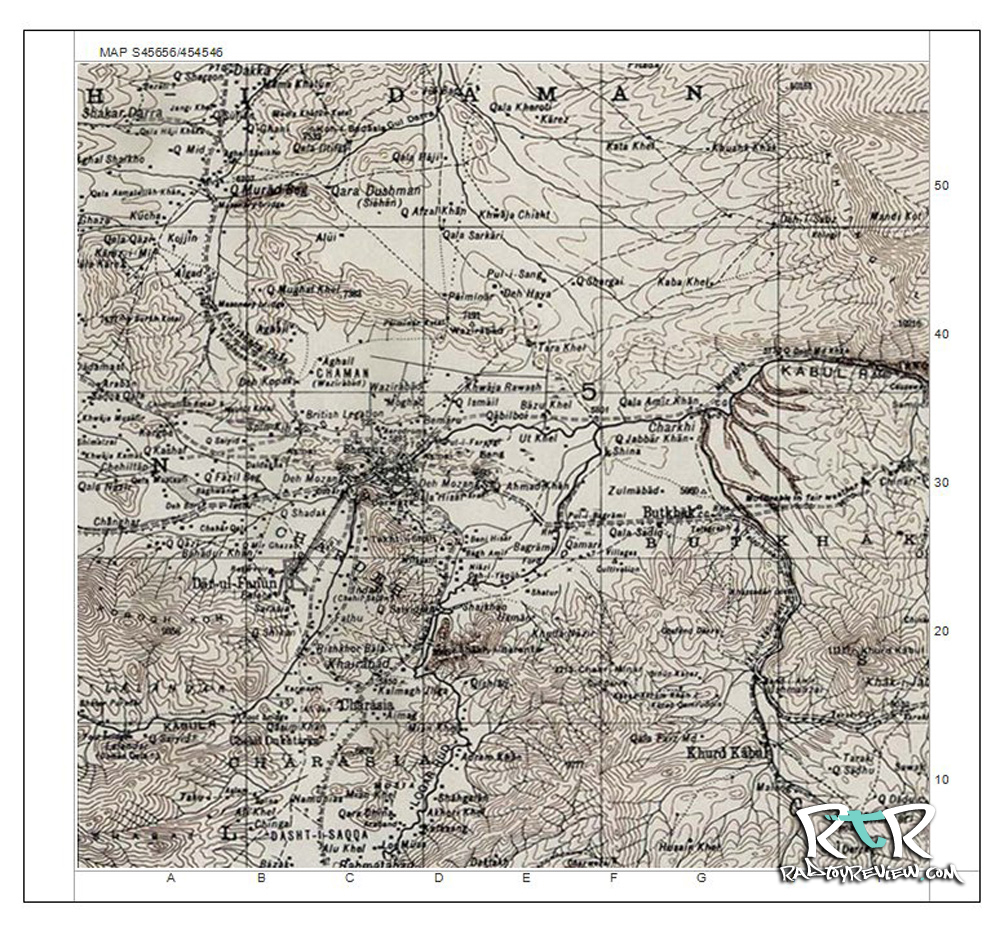
15.  The map is made using the magic of a Google search and Photoshop.  It is an old map of a desert area. I simply printed it out and cut it to size. I gave it a bit of ‘usage’ by wadding it into a small ball and then flattening it back out. Then I gave it realistic tight map folds. After that desert sand weathering powder was rubbed onto the map, both sides, with a brush.
16.  The tool case was a clear plastic box for screws.  It was painted in the same way as item 3.  To personalise it, I painted a skull and initials by hand.
17.  The rope is a 1/6 scale WWII climbing rope that came with a different figure.  Tied off with thread it was then light drybrushed with a desert sand/ white mix.

pic x Paul Benson

We hope you enjoyed the latest Workshop. Thanks to Paul for once again putting this together for us. Now get out there and customize something!
 We’d love to hear from you and check out what kind of customs you’re working on! Send us a shot of your latest custom work with a brief discription to radtoyreview@gmail.com. 

Hit us up on Facebook or Twitter pages to stay updated whenever we post new Workshops and epic toy reviews!

Until next time!


THE WORKSHOP – DIY 1/6 machete by Paul Benson

Today you’re going to learn from my main man Paul Benson how to fashion a made from scratch machete for your wee plastic army. Break out your tiny tools and follow along!

– Knives

THAT’S NOT A KNIFE, THIS IS A KNIFE.
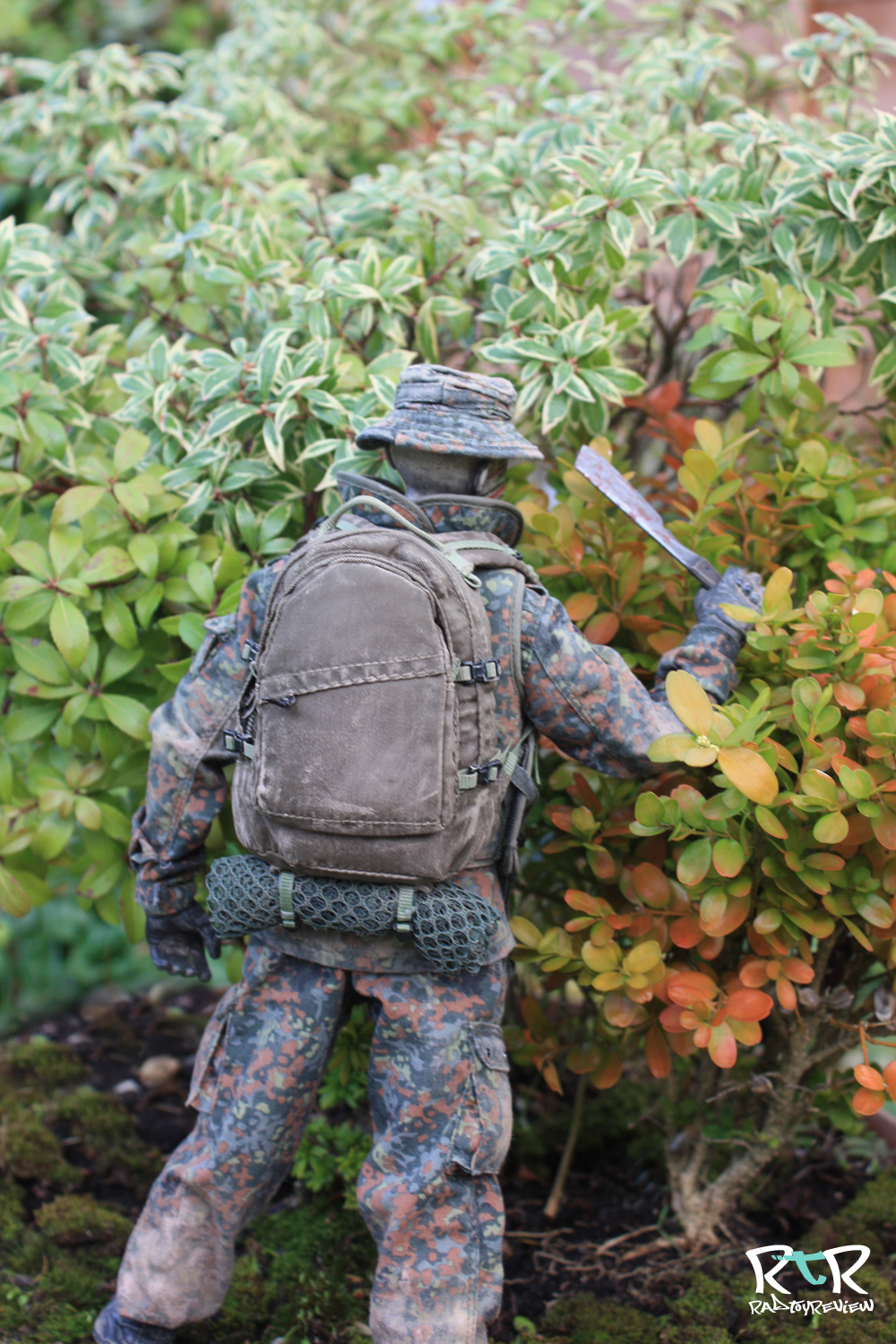
Missed out on the ThreeA Jungler Ranger Grunt and then regretted having done so ever since, so I have kitbashed my own.  Although the camouflaged kit I have used tends to suggest temperature forest rather than tropical jungle.  I thought he still needed a machete to aid  movement through heavy vegetation, ground clearance, cutting wood for fires etc.

The design I went for is similar in design and size to the British Army Bushcraft machete.
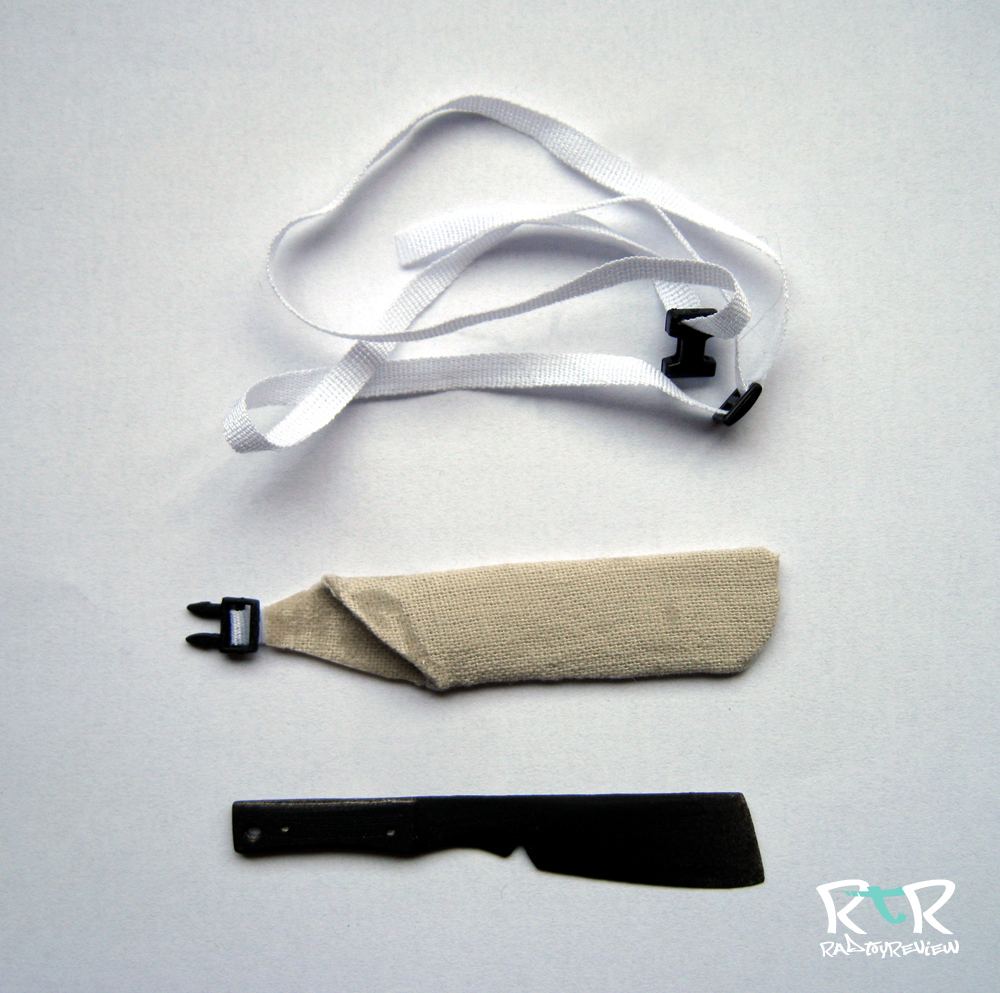
The materials I used were 3mm sheet balsa, 1mm sheet styrene and 3mm Grosgrain and linen cloth.  The paints were a Humbrol acrylic aerosol spray, Games Workshop acrylic paints and a MIG weathering powder.
To make the machete the outline was drawn on a piece of sheet balsa and cut out with a sharp scalpel.  It was then shaped with a scalpel and then with sandpaper.  An edge to the blade was made with fine emery paper.  The blade was then painted with super glue to harden the surface several times.  Sand it down again to get a very smooth surface. The hand end of the machete was then used as a stencil to draw two grips onto 1mm styrene sheet.  Cut them out and glue in place.  “Screw” holes were drilled with a scalpel blade.  To give the impression of wood grain I scratched the styrene handles with a scalpel blade point.
To make a sheath of the correct shape and size, I used the machete as a stencil to draw out the form on styrene sheet. The shape was then cut out with scissors.  I’d never suggest that I’m very good at sewing.  Buttons tend to be my limit. So assembly of the sheath was not done with finely sewn lines, I used super glue!! Use what you’re comfortable with.
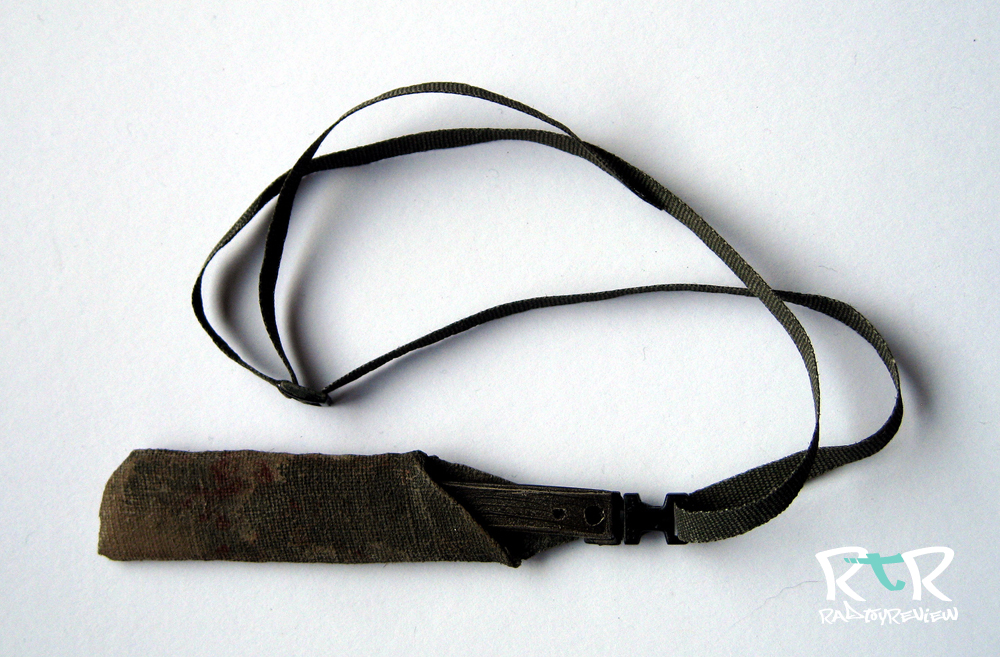
The first step was to cover the styrene shape I had made.  The fine linen material I used was wrapped round completely with a slight overlap and then cut.  A few dabs of glue here to hold it fast.  Where straight lines were needed, the linen was painted with super glue which hardened it and made it very easy to cut clean.  Games Workshop super glue is superb for this job, as the pot it is in comes with a small brush.  The back of the sheath won’t be very neat, but no one should see it anyway. A second piece of linen was used as the front of the sheath and again glued around the back as neatly as possible.  To create an edge to the sheath where the machete would go in, the linen was folded over and glued inside. The top part of the sheath was painted with super glue and cut neatly.  A short loop of Grosgrain was looped through one half of a 1/6 side release and glued behind. At this point you can clean it up by cutting any loose threads.
The webbing body strap was 3mm Grosgrain cut generously (it would be cut to the correct length later once on the figure) and looped through the other half of the side release.  The sheath could just have easily been attached to the loop webbing on the figure.
The machete was then sprayed with Humbrol matt black acrylic aerosol paint.  When dry the blade was dry brushed with Games Workshop boltgun metal acrylic paint. Unfortunately I was too vigorous and knocked of a little of the blade at the end. The handle was painted with GW scorched brown and when dry further dry brushed with scorched brown mixed GW skull white. The webbing strap and sheath were painted with GW catachan green acrylic paint mixed with a little GW chaos black. It was then dry brushed with catachan green mixed with skull white.  To highlight the weave on the webbing and sheath, they were both finally dry brushed very lightly with skull white by itself.  To dirty up the sheath dry mud MIG weathering powder was mixed with a little GW skull white and dabbed onto the sheath, this would match what I had done to the clothing of the kitbashed grunt I had made the machete for.  To add a little bit of rust to the machete I used GW dark flesh lightly dabbed on with a small piece of natural sponge.  The technique is all about trial and error, for example I dabbed the piece of sponge (around 4cm by 4cm cut from a bigger sponge) into the paint and then dabbed it onto paper.  When I got a random pattern of small randomly shaped marks I was happy with, I applied the sponge to machete blade.  Where I need more marks I rotated the sponge and dabbed again.  I did the same technique on the sheath to add a little visual interest, although rust from the machete blade may well have got onto the sheath anyway.
We hope you enjoyed this episode of The Workshop. Thanks Paul putting together for us. Now get out there and customize something!

We’d love to hear from you and check out what kind of customs you’re working on! Send us a shot of your latest custom work with a brief discription to radtoyreview@gmail.com. 

Hit us up on Facebook or Twitter pages to stay updated whenever we post new Workshops and epic toy reviews!

Until next time!